


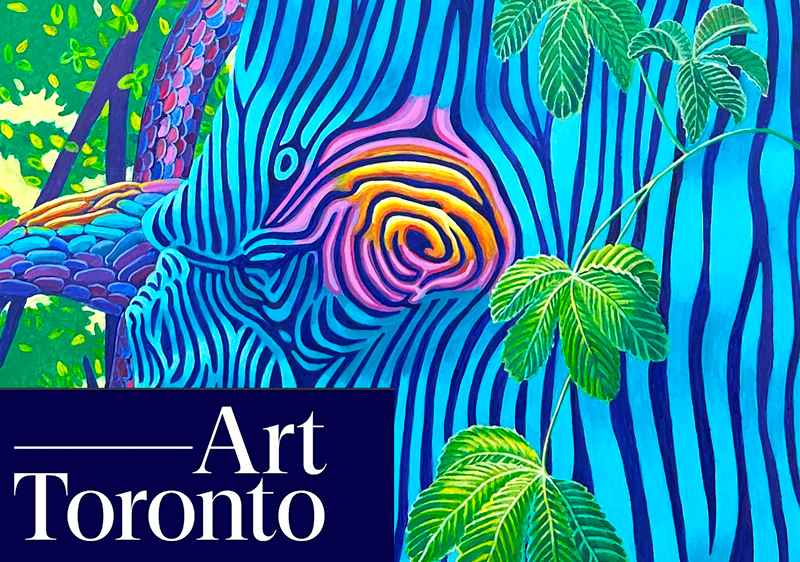
19 Aug ART TORONTO 2026
From October 29th to November 1st
Marking our inaugural participation at Art Toronto, Canada’s foremost contemporary art fair, we are pleased to present a solo project by Conchi Álvarez. The exhibition features a new body of paintings centered on themes of Paradise and Eden, with particular prominence given to the Tree of Life.
THE TREE OF LIFE, Axis Mundi
In the presence of an artwork of such allegorical magnitude, the ostensible thematic simplicity—which at first glance transcends and surpasses any expectation of a straightforward and immediate understanding—becomes intrinsically linked to the intensity of the chemical interaction between lapis lazuli, vermilion, and gold, transmuting the alchemy of the pigments, the mastery of the craft, and the artist’s transcendental ego. This places us, in admiration, before a panel/door that compels us to tilt our gaze from bottom to top and vice versa, immersing us in the enchantment of this uniquely personal tree—a zenithal achievement in the artistic career of Conchi Álvarez—hinting at unforeseen metameric allusions to the numinous symbolism of vegetation and trees.
The natural biological tree has long been understood—if we take as a reference M. Eliade’s studies on religions and pre-civilized cultures—as the materialization of the Living Cosmos in its manifest and ceaseless regeneration. From this biological condition of regeneration, which remained unintelligible to the earliest religions, the vegetal world, and especially the tree, has held an irreplaceable position as the central object of ritual, mystical, cosmological, or purely symbolic ceremonies. As an inexhaustible and self-sustaining source of life, its natural force is equated with immortality and, by analogy, with the identification of the natural tree as the Tree of Life Without Death. Symbols of the center appear in various forms, for every hierophanic space—temple, city, tree, mountain—is, at once, a symbol of the center, as it embodies absolute reality, sacredness, and the source of life (immortality). Yet among all these, three fundamental ones stand out: the Cosmic Mountain, the Central Pillar or Column, and the Cosmic Tree or Center of the Universe, the beginning and end of the world in itself—the Axis Mundi, the most widespread and recognized of them all.
From those primordial religions centered on vegetation, stones, and animals in India or Mesopotamia, the various valences of the Tree have gradually evolved over the centuries—discontinuously in time yet constant in their functions—eventually becoming a divine object by virtue of its resilience and the power it manifests, as it transcends the fragility of other numinous yet perishable beings. The primary power of the tree, as seen in the work of Conchi Álvarez, is substantiated in its ontogenesis, its resolute physical presence within a paradisiacal context. The Tree of Paradise is imbued with sacred connotations, evoking weightless verticality and the eschatological symbolism of its growth from earth to sky. The quintessential primordial cosmic tree is Yggdrasil, whose roots extend into the heart of the earth while its towering canopy reaches the heavens, where both the realm of the giants and the underworld of Scandinavian mythology reside.
There are countless myths and legends featuring a sacred or cosmic tree, a pillar that upholds the world, a Tree of Life, or a miraculous tree that grants immortality to those who savor its fruit. All these myths and logical ontologies converge in the vision of the Axis Mundi.
In Genesis, the Tree of Life and the Tree of the Knowledge of Good and Evil are specifically mentioned among all the other trees in Paradise. The Vedic texts speak of a tree whose sap gives life. As highlighted by the entire hermeneutic (allegorical) tradition of the Scriptures, initiated by Philo of Alexandria, innocence and the primordial unity with nature were lost when man ate the forbidden fruit from the tree of knowledge. At that very moment, heaven and earth were separated, man was expelled from Paradise, and communication between gods, animals, and humans became impossible.
For the early Christians, the tree symbolized the Cross of Redemption and was frequently depicted in Christian iconography as a Tree of Life, as both represent the destruction of death. According to the development of Christian theology, the tree of Christ’s cross came from heaven to provide a complementary and definitive resolution to Adam’s fall. If the first tree had brought sin and death, the Tree of the Cross was to bring salvation to the world through the death of the Son of God.
Throughout the Middle Ages, an abundant number of legends regarding the wood of the Cross circulated across all Christian lands. In England, for instance, the Cross of the Evesham Psalter, dating from 1250, gained considerable fame, depicting Christ not crucified upon two crossed beams, but upon two branches shaped like a cross, which mimicked a tree. Beside Him stood the Virgin and St. John, while above the image, two angels held two discs bearing the faces of the sun and the moon.
In Germany, we find the dolorous crucifixes of Coestfeld and Bocholt, also known as Gabelkreuz, whose distinctive feature lies in the absence of a horizontal crossbeam, replaced instead by two slanted poles forming a Greek letter Y. The singular shape of these crucifixes, in the form of a Greek Y, has long been attributed to the intention of replicating the appearance of the trunk and branches of a tree, thereby associating the cross with the Tree of Redemption and the tree through which the first sin of the world was committed.
In Conchi Álvarez’s Tree of Paradise, the Xylem is a lignified plant tissue rendered in varying shades of blue, through which wisdom flows from the roots to the leaves, traversing the imposing body of the Tree of Redemption. Through this conduit runs the artist’s vascular vitality, distributing her conceptual purity, fortune, and nobility, symbolized in the colors surrounding the two golden alburas. These, unable to become branches with flowers due to the serpent that lurks, spits evil, and flees, are now luminous essential knots that constitute the allegorical authenticity of this painting. A contemporary work that employs the exotic color palette once sought by the great Renaissance painters—Leonardo, Dürer, Giotto, or Fra Angelico—in their canvases. Blue gold serves as the aesthetic fulcrum of a flat drawing, where two dimensions of materiality coexist in the same possible anthropological space: man, things, and God.
Roberto Ballesteros

CONCHI ALVAREZ
“Painting is my way of engaging with the symbolic structures that endure across time. Drawing on my background in Ancient History and Archaeology, I approach each work as an excavation—not of material remains, but of the myths, rituals, and archetypes that continue to shape our cultural imagination.
I am interested in the ways symbols survive, transform, and acquire new meanings. Trees, ancestral figures, and vernacular iconographies are not motifs to be illustrated, but living forms through which I explore memory, identity, and our relationship with the sacred. Rather than reconstructing the past, I seek to reveal its continuous presence within contemporary experience.
My paintings are built through layers of color and gesture, allowing images to emerge gradually, as if they carried the traces of earlier histories beneath their surface. I see painting as a space where time collapses, where inherited narratives can be questioned, renewed, and reimagined.
Ultimately, my work is an invitation to look beyond appearances and to recognize that the deepest structures of culture are never fixed. They remain alive, evolving with us, offering new ways to understand who we are and how we inhabit the world.”
Conchi Alvarez
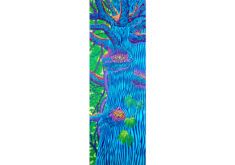
EL ÁRBOL (THE TREE)
Acrylic on panel
191 x 65 cm/75,2 x 25,6 inches
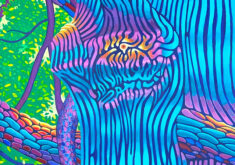
EL ÁRBOL (THE TREE). (Detail)
Acrylic on panel
191 x 65 cm/75,2 x 25,6 inches
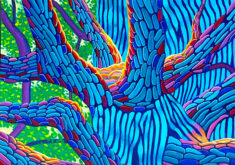
EL ÁRBOL (THE TREE). (Detail)
Acrylic on panel
191 x 65 cm/75,2 x 25,6 inches