


DEFIANT WARPS
A new solo exhibition by Mexican artist Astrid Sommer. Large, unframed canvases, freshly taken down from the walls of her studio to journey to Spain and be displayed. As is customary of this painter, the pieces embody the very essence of horror vacui. A multitude of symbols, brushstrokes, and paint drips executed with the impulsiveness that defines her. She requires no preliminary sketches, for it is passion that drives her gestures, and a vital optimism revealed through the vibrant, luminous, and bold colors so distinctive of this artist. On this occasion, more than ever, she seeks to champion the use of what she calls “color in freedom.” Astrid further describes her work as “a visual rebellion against the aesthetics of silence” and “a call to reclaim the right to feel and to see in color.” For this reason, she explains, “the fabrics, freed from their frames, hang like banners of the cause.”
STROMATOGRAPHIES. Veiled realities.
The vocable Stromata, derived from the Greek stroma (στρώμα), meaning warp, woven fabric, or miscellany, was first employed by Clement of Alexandria in his work bearing the same title. In it, he reflects upon the significance of the Mosaic tradition as a foundation for bearing witness to the Christian faith—one rooted in solid and skillfully interwoven principles—responding not only to the challenges posed by philosophers and sages opposed to that faith, but also guiding the disciple toward the purest essence of belief. The Stromata, he tells us, are designed to artfully conceal the seeds of gnosis. It is an endeavor to attain truth, for just as the hunter secures his prey only after searching, tracking, and following its trail, truth is all the sweeter when won through effort. The Stromata veil the truth from those inclined to contradict all things. That “stubborn reality,” resistant to conjecture, to falsifiable theories, to the metaphysics of deduced truths, can only be tamed upon the loom of warp and weft, weaving and unweaving the manifold ways of configuring the obverse and reverse in the symploké of all things.
Taking advantage of the presence in the gallery of Astrid Sommer’s new collection of painted canvases, it struck me as no coincidence the analogy between the veiling of faith before the sophists in Saint Clement’s stromatic discourse and the veiled personal cosmos within Astrid’s abstraction. In the works of this Mexican artist, I perceive a kind of—if I may be permitted the neologism—stromatographies, considering that the construction, format, and teleological intent of her painting, in her own words, seek to challenge the sensory apathy of the contemporary world—if we translate apathy as a form of artistic agnosticism. Accepting this analogy, we are thus confronted with a pictorial configuration that proposes a magical interplay of concealment of “spiritual” realities from within her particular cosmos. What she brings to the gallery is a collection of abstract pieces, a collective act of color, a visual choreography of interwoven hues and tones, with tangible references to the popular arts of the master weavers of Mexican huipiles and preserved ancestral traditions—traditions that employ as their raw materials artisanal patience and the natural products of their environment.
In these rendered stromatographies, Sommer affirms that she does not paint recognizable forms—she invokes sensations. But then, why does Astrid, in a manner veiled within abstraction, allow traces of childhood to seep through, of joyful disorder, of the fearless intensity of red, of blue without justification, of yellow that seeks no permission and instead invites unrestrained feeling, vision without neutrality, a reclamation of color’s transformative power—its rightful place in the everyday, its capacity to articulate what words have long silenced? Naturally, the answer can only be discerned in direct encounter with the canvas. It is there that the artist’s spiritual cosmos becomes transubstantiated; there, her craft transcends the limits of technique; there, the nematologies of her mind are transfigured upon the woven surface—hidden behind them are the truths of a reality unspeakable, imperfect, unpresentable as a mirror of the self—veiled, in a word: abstract.
But is liberal art truly liberating in any concrete sense? Nowadays, perhaps, it offers some relief. The fine arts, or liberal arts—not liberating arts, as is well known—stand in contrast to the so-called useful arts, whose essential purpose lies in the production or acquisition of goods or services external to themselves. The liberal arts have not enjoyed the same fortune as, let us say, the arts of fishing, which have always served to capture the finest fish with precision, or the arts of war, which aim at devising the most effective means of annihilating the enemy. These are arts with a goal, with utility as their telos. By contrast, the liberal arts are not subordinated to anything beyond themselves. It was, once again, Kantian idealism that, in The Critique of the Power of Judgment (1790), attempted a redefinition of the liberal arts through the lens of purposiveness, encapsulated in the maxim Ars Gratia Artis—art for art’s sake—deducing that the art of the liberal arts, such as painting, sculpture, and music, is directed toward an end, yet a most peculiar one: an end without an end. A distinguished pleonasm that has endured nearly to the present day, albeit with consequences far from idealistic—consequences upon which Baumgarten erected his Aesthetica in 1750. He would call it lower gnoseology, for it deals with sensible knowledge, whereas higher gnoseology pertains to rational or logical understanding.
Yet perhaps we ought to consider, contrary to what has been previously stated, that the liberal arts may offer an ontology—a mode of being—that can, in and of itself, constitute a form of useful finality from a noetological perspective. In this light, the notion of art as purposeless might unexpectedly approach the necessity of ends, as found in the most rigorous sciences—those sometimes referred to as alpha-operatory—that is, artistic works that have succeeded in segregating from within themselves the operative subjects who created them, thereby forming a synthetic identity of their own. Such works approach the morphologies that define reality, aligning themselves with the productions of inorganic Nature. Upon this new morphology—proper to matter in its degree of artistic materiality—gains meaning the presence of other sensibilities, participating in the play of useful art, striving to share those realities obscured by genius within abstraction, as in the case of Astrid Sommer. Ultimately, these are liberal artworks that become useful for deepening our simple understanding of things, whether born from contemporary artists who embrace the freedom of abstraction, or from humble artisans who meticulously craft painted textiles with cochineal drawn from the nopal cactus.
Regarding the adjectives Astrid Sommer places in the margins as titles for her works, one might say that they belong to a distinct class of semantic relations between the name and the named. Joyful, hopeful, impulsive, or bold seem to me to be universal qualifiers that, rather than defining the piece, serve to assist its perception—surrounding it with a preferred emotional climate conducive to ambient enjoyment. In doing so, they offer a gentle counterpoint to the overwhelming improvisation emanating from the striking stromatic outcomes. It is, perhaps, something akin to A Love Supreme, the thematic phrase John Coltrane assigned to his most abstract and spiritual composition.
Roberto Ballesteros
Curator

ASTRID SOMMER
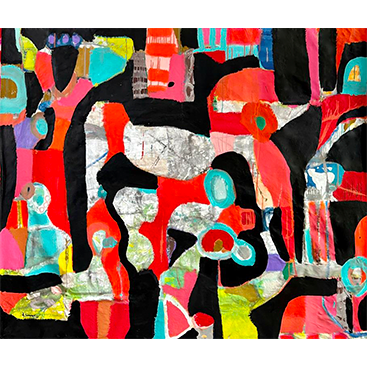
DARING
Acrylic on canvas
150 x 180 cm
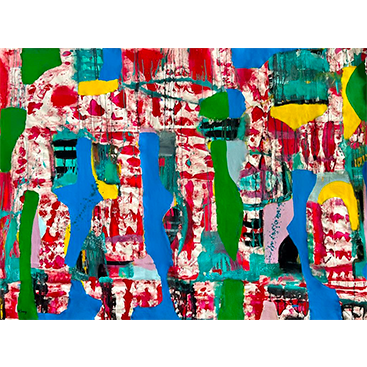
BRAVE
Acrylic on canvas
150 x 195 cm
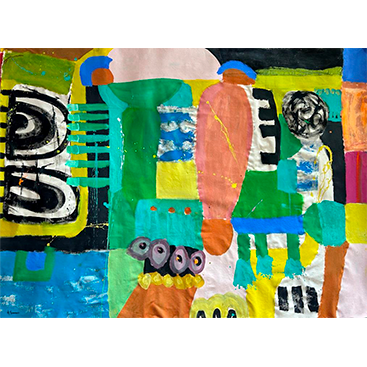
DETERMINED
Acrylic on canvas
150 x 195 cm
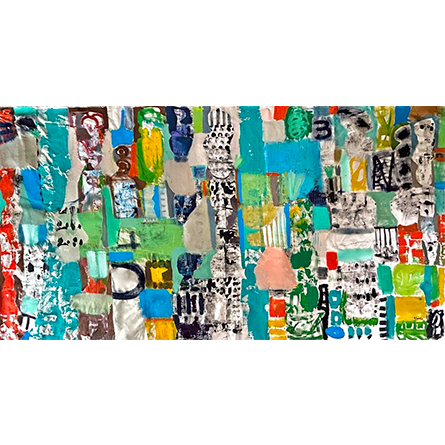
HAPPY
Acrylic on canvas
200 x 400 cm
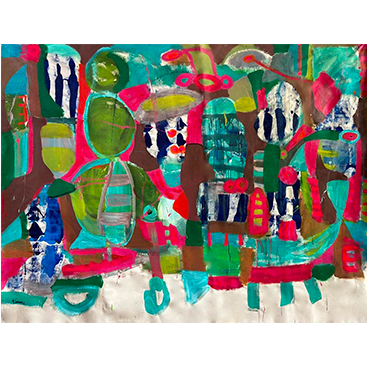
IMPULSIVE
Acrylic on canvas
150 x 195 cm
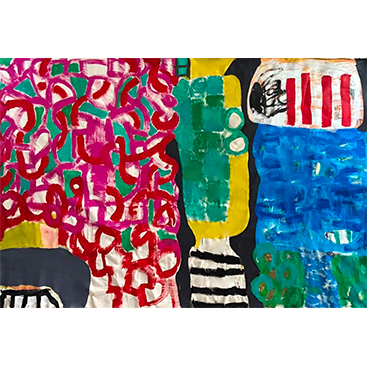
INTREPID
Acrylic on canvas
200 x 300 cm