THE SOUL OF BEAST


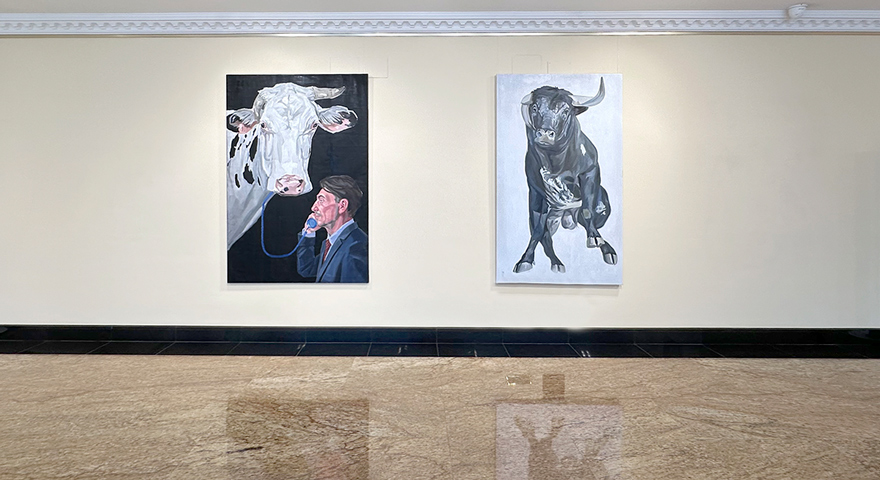
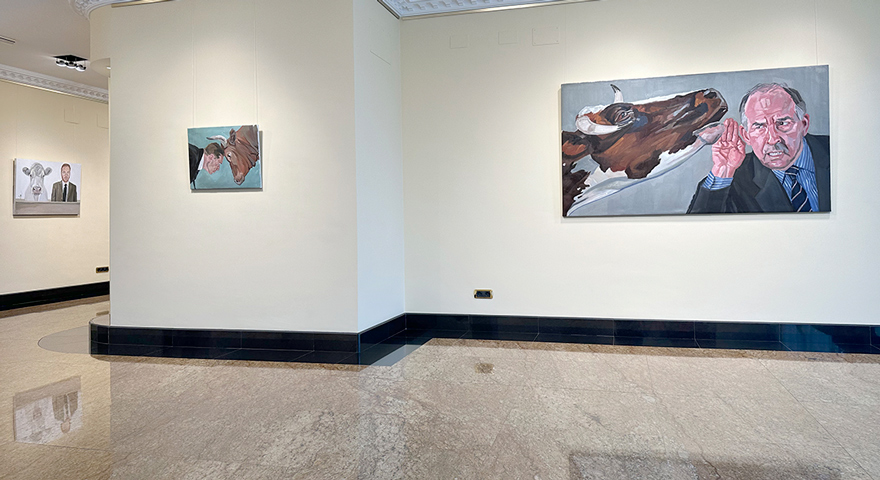
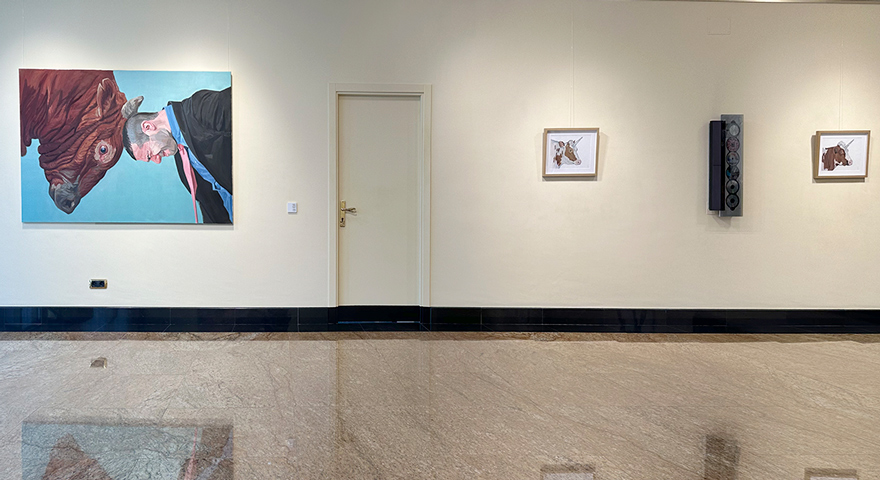
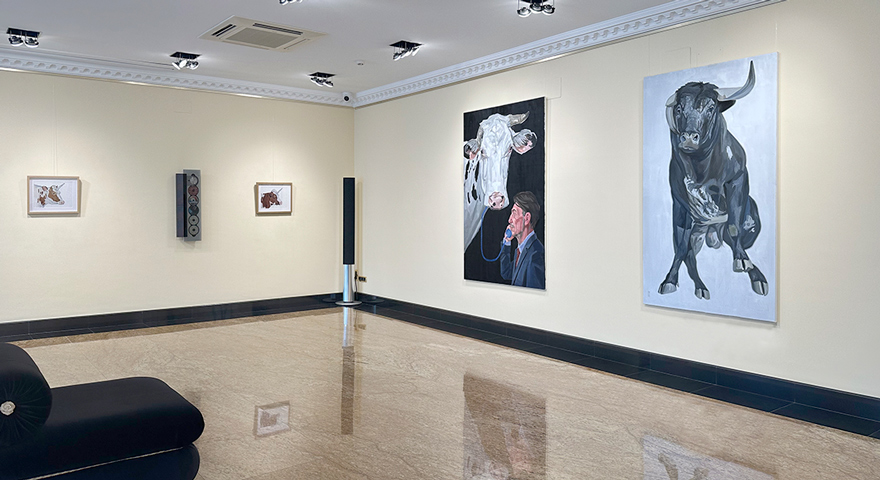
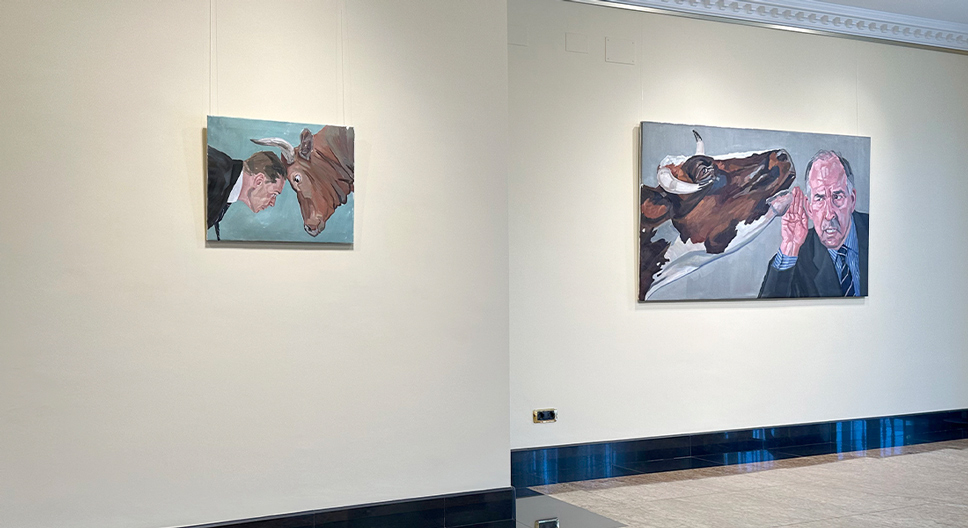
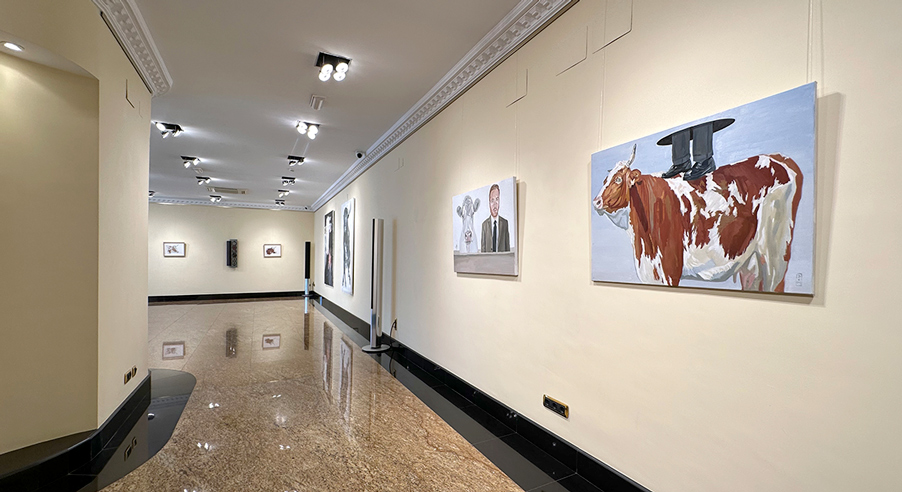
“The Soul of Beats” is the second solo exhibition by artist Diego Cerero at STOA.
The world of the heteronym cow and bull, and their connection to humanity, is one of the most recurring themes in the work of this young Huelva-born artist. Diego’s decision to live in the countryside and interact with animals is no coincidence, as it is reflected in the lack of aggression in his bovines and the astonishing and seductive anthropomorphic behaviours. His large oil paintings on canvas are executed with agile brushstrokes and abundant painterly material. Some smaller oil-on-paper works abound in the surreal atmosphere that permeates this exhibition.
UNEXPECTED ETHOLOGICAL CONNECTIONS: The Soul of Beasts
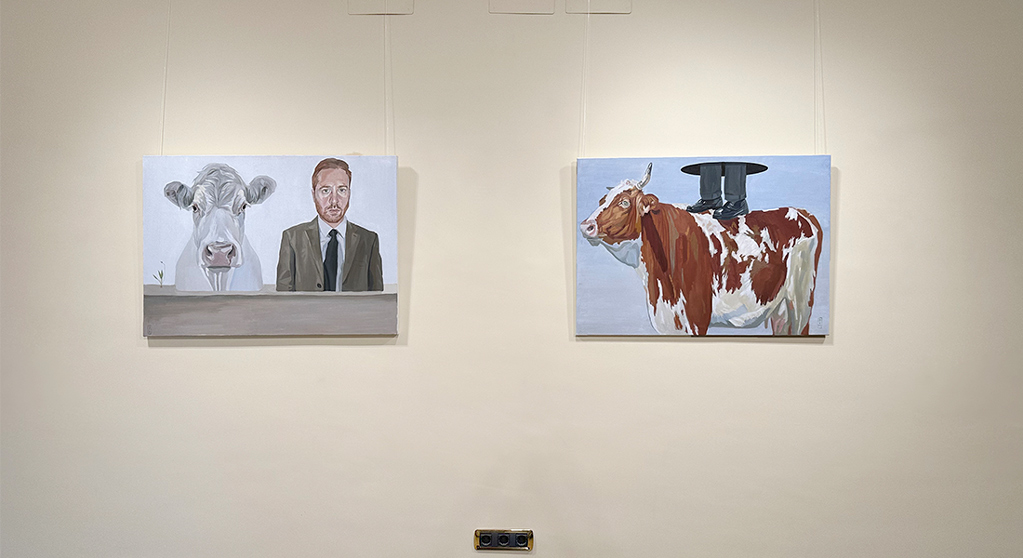
Diego Cerero’s Self-Portrait with Cow immediately suggests a dialogue between the human and the animal, the rational and the instinctive, the urban and the wild. The fact that this portrait is conceived as a double frontal figure—with the cow and the artist occupying the same plane—conveys an impression of apparent ethological parity, a kind of mirror of souls between two beings who gaze upon each other without hierarchy, sharing the same silent complicity. Both regard the viewer with equal gravity. The man’s suit, set against the animal’s naked body, underscores the cultural distance between them: the social as opposed to the biological. Yet the serene tone and neutral light dispel any trace of drama; there is no conflict here, but rather reconciliation. One might also interpret it as an allegory of a divided soul, in which the cow embodies the earthly, tranquil, and patient dimension, while the man represents the reflective or self-aware dimension. The small green sprout on the left introduces a third element—perhaps life itself continuing, nature persisting beyond the existence of individuals, untouched by humanity and the brutish souls that accompany it. Taken as a whole, the work appears to be a contemporary meditation on the animal within man and the human within the animal—a kind of philosophical reflection on the soul of beasts, or, to phrase it in terms less opaque and closer to modern readers, on the soul of animals. That is to say, something seemingly as metaphysical as the Soul is, in truth, a reference to animal and human behavior—so similar in their general traits, as Ethology has long observed in the wake of evolutionary theory, particularly since Darwin’s celebrated work The Expression of the Emotions in Man and Animals (1871). Such, then, would be the problem of the Soul of Beasts: the historical and philosophical relations between humankind and animals.
In this new exhibition by Cerero, the works presented by the artist deactivate the hierarchy between the human and the animal. This compels us to reflect upon the continuity of the living as a phenomenon of distributive consciousness. If the cow also gazes, then it also feels, interprets, and responds. The viewer, unwittingly, enters into a moral relationship with the artist’s proposition. The painting thus becomes an ethical experience, wherein the spectator may come to perceive the gaze of the animal—silent, equal, and leveling. The connection with the soul of the animal is attempted, and the figures appear to await a response. The work perhaps suggests a visual inquiry into coexistence. The human ceases to be the center and becomes instead a perspective that foregrounds ethos over ego. This decentering constitutes a transcendental egological thesis, one that redefines coexistence between the brute souls of animals and the cultivated soul of humankind.
From an ethological standpoint, the animal is the being that acts according to its instincts, its biological rhythms, and its belonging to a group or environment. It represents the objective dimension of behavior—observable, natural. In the painting, this would be the cow—but also the bodily gesture, the stillness, the material presence of the living being. The egological animal, the human is the being that knows itself to be alive, that represents itself, that seeks meaning or identity. Each work thus becomes a point of intersection between these two planes: the animal that acts and the one that thinks, the body that feels and the subject that composes, that re-creates.
Diego Cerero’s proposal thus becomes an ethological-artistic, reflective and fertile experience. Beyond its literal dimension, it may be understood through an appropriate subjectivity and, in dialogue with the work itself, through the position each of us occupies between the biological and the animic, between the animal and the person. The artistic situations represented in this ethological–egological collection open a door usually closed to viewers, inviting a transcendental analysis that moves beyond the visual plane within contemporary art. Beyond that threshold, pairs of philosophical Ideas emerge, corresponding to the customary terms employed within the Scholastic tradition to speak of the Idea of the Soul and its “faculties”, Knowledge, Desire, and Feeling. Thus, we may discern the following conjugated conceptual pairs—some of them interrelated two by two—Soul/Body; Knowledge/Action (Desire); Knowledge/Passion (Feeling). There exist two kinds of conjugated conceptual frameworks: the metameric, which conceives these pairs as solid, unified blocks; and the diametric, which assumes that each concept is divisible into parts and may relate to others according to those divisions (as Rest and Movement).
In metaméric frameworks, the classical doctrines concerning the Soul of Beasts are situated. The pair Soul/Body highlights the juxtaposition scheme upheld by Scholastic philosophy, in which soul and body are assumed to be two separate substances whose union is decreed ad hoc, with apparent evidence. The physician and philosopher from Valladolid, a precursor of Cartesian dualism, Gómez Pereira (1500–1558), could be seen as practicing this kind of metaméric reduction scheme, insofar as he reduced the Soul of Beasts to the operation of sympathies and antipathies—or of animal spirits—that is, ultimately, of the body. It is well known that Descartes later revived the thesis of animal automatism; and since he reflected far more than he read, it could be believed that he was unaware of Pereira’s assertions. Yet some critics accuse the celebrated French philosopher not only of appropriating the Spaniard’s ideas, but also of secretly orchestrating the destruction of Pereira’s published works—a darkly legendary ostracism.
Then, could Failed Connection and Wired Connection be understood as an allegorical attempt to engage with the Soul of the Cows? It is said that, if language is understood as a means of conveying thoughts with ease (perhaps Figure with Cow 1 and 2?), it becomes evident that any animal not living in absolute solitude must possess its own language, and that it would be impossible for animals to live as they do in society without some means of understanding one another and communicating their ideas. Ants give one another the necessary warnings when it comes to pilfering provisions. Swallows all come together to promptly construct the nest for a female who is about to lay eggs and has been accidentally abandoned, summoned by the same female emitting plaintive cries. Bees help one another to remove from the hive the corpses of their companions.
And… could it be the desire of the Cows, once communicated and perceived in their lowing and gazes, to have a simple unicorn celebration arranged for them, in order to escape their customary routine?
Roberto Ballesteros

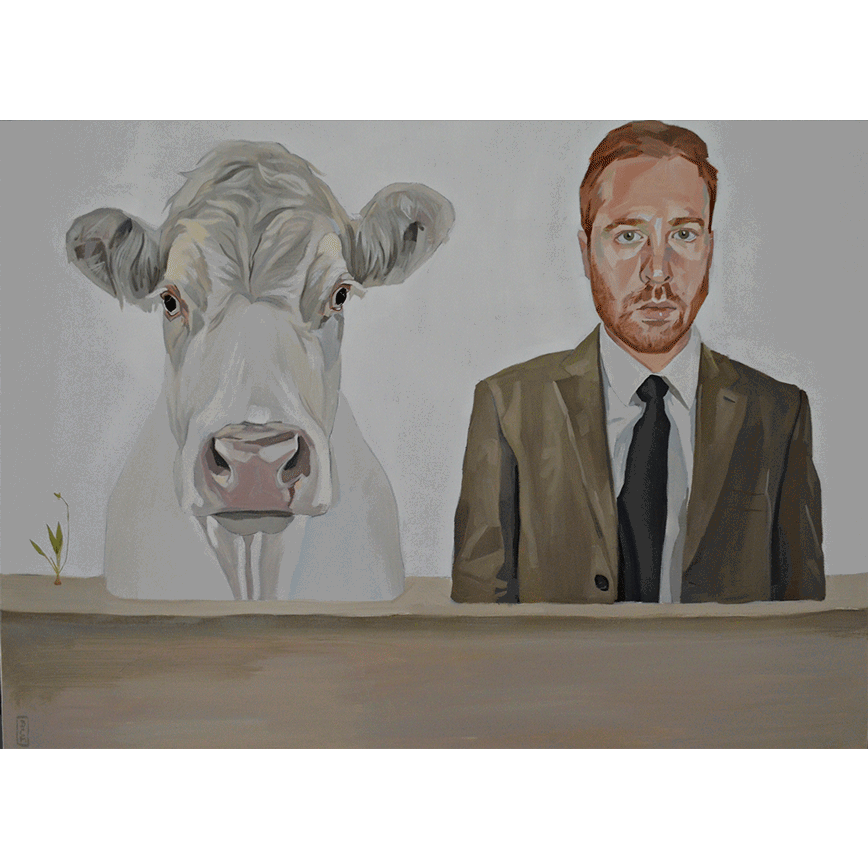
SELFPORTRAIT WITH COW
Oil on linen
73 x 100 cm
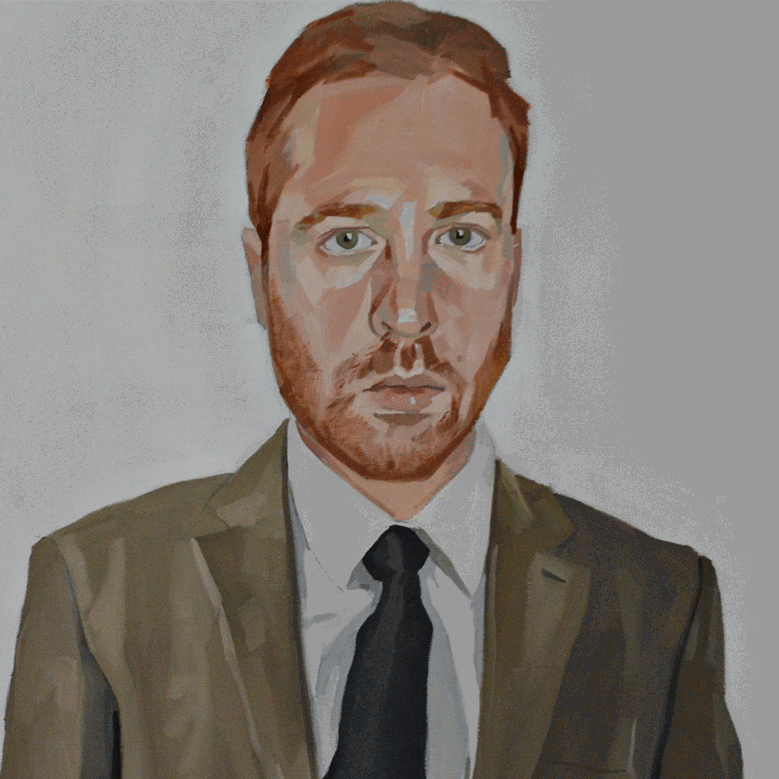
SELFPORTRAIT WITH COW. Det.
Oil on linen
73 x 100 cm
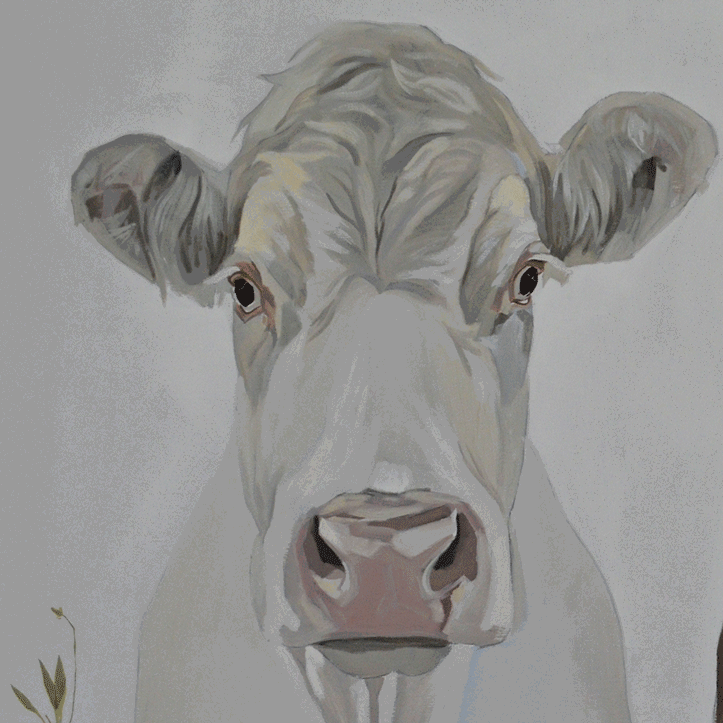
SELFPORTRAIT WITH COW. Det.
Oil on linen
73 x 100 cm
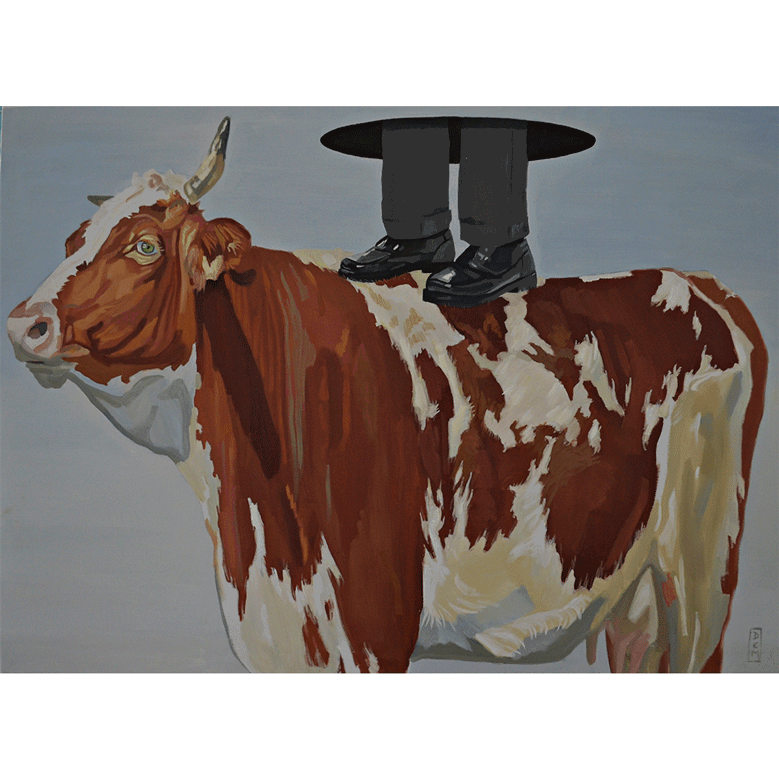
SELFPORTRAIT ON COW
Oil on linen
73 x 100 cm
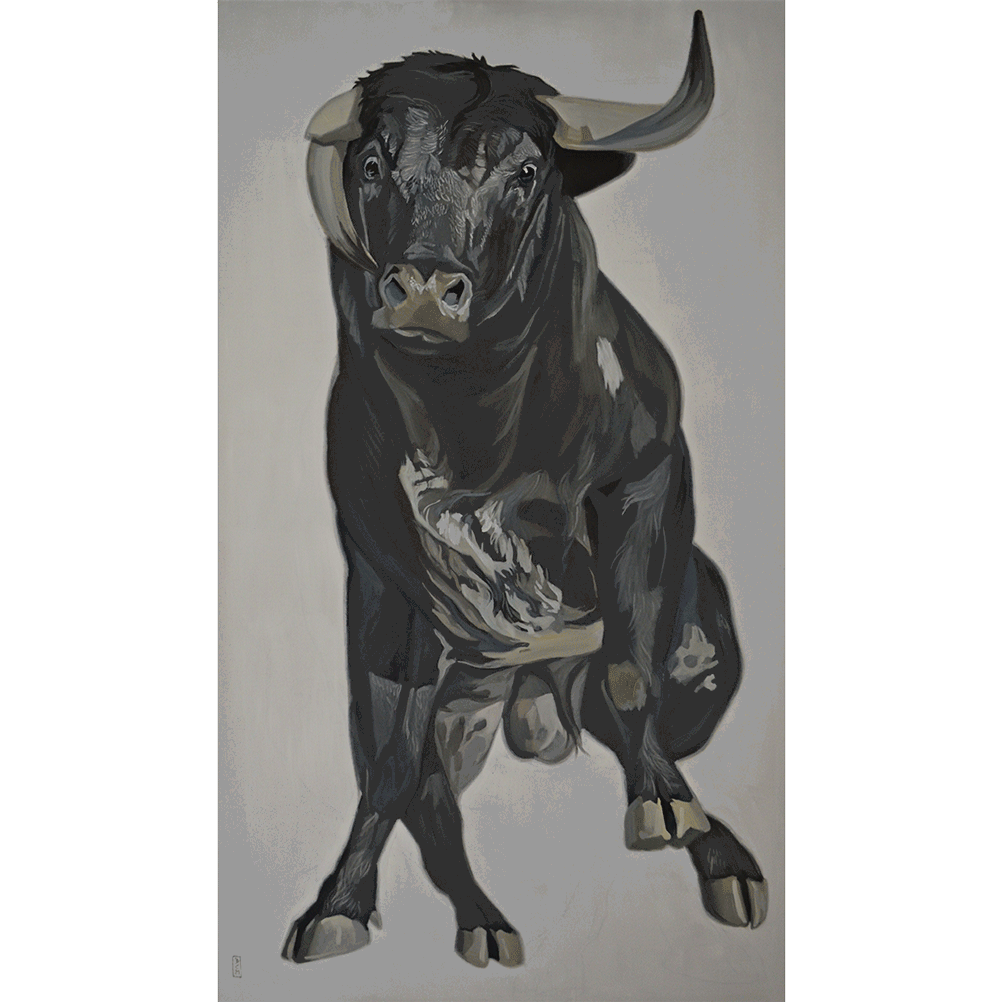
THE FLIGHT 2
Oil on linen
195 x 114 cm
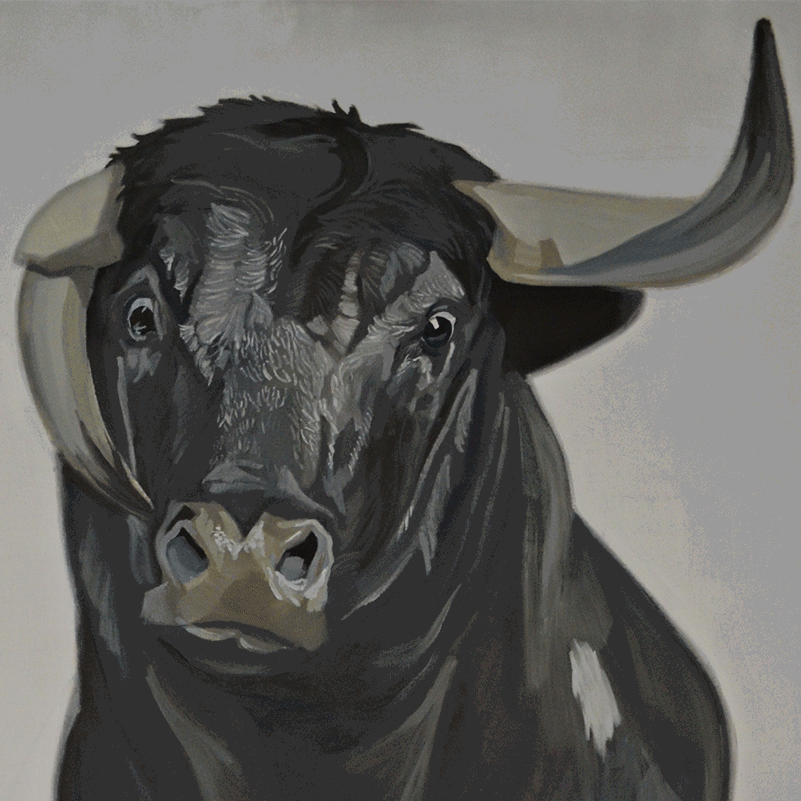
THE FLIGHT 2. Det.
Oil on linen
195 x 114 cm
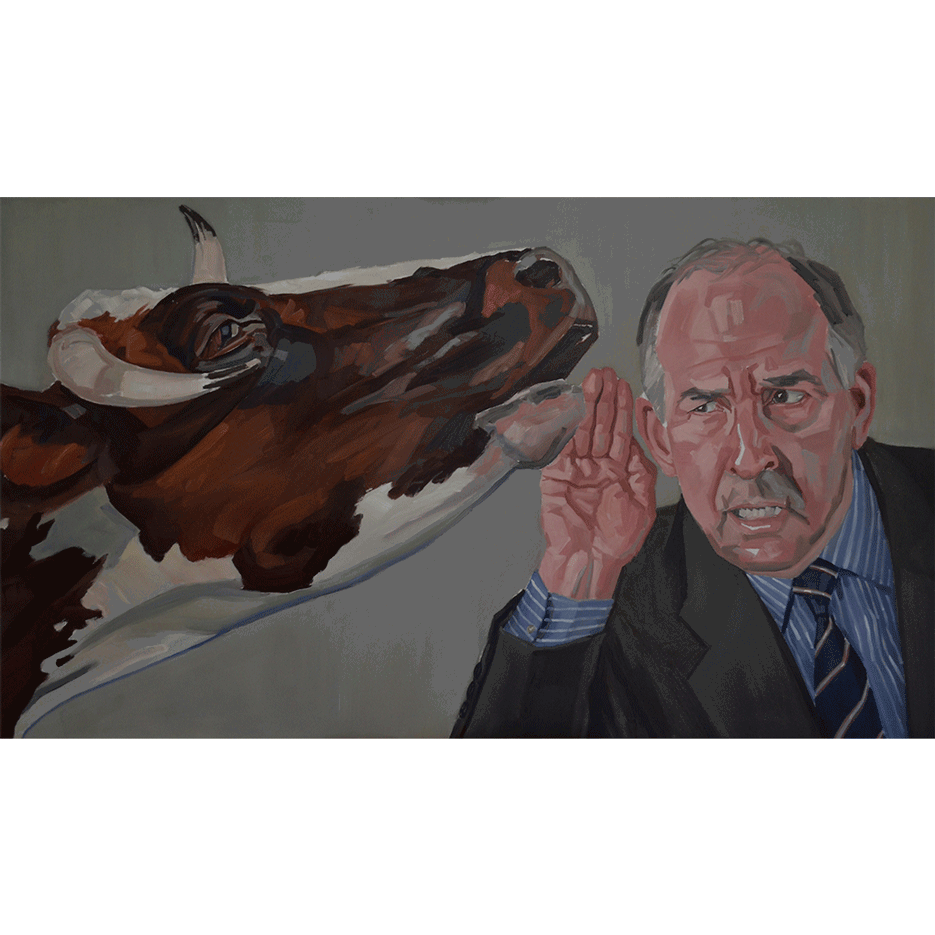
FAILED CONNECTION
Oil on linen
114 x 195 cm
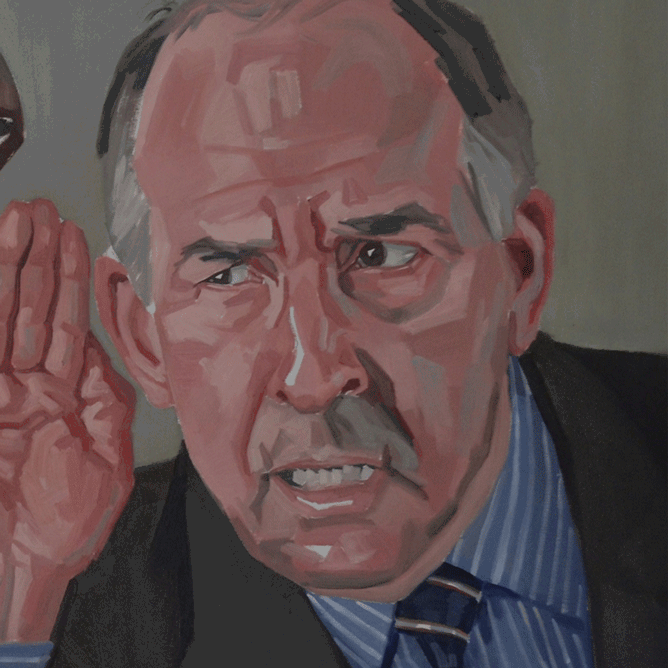
FAILED CONNECTION. Det.
Oil on linen
114 x 195 cm
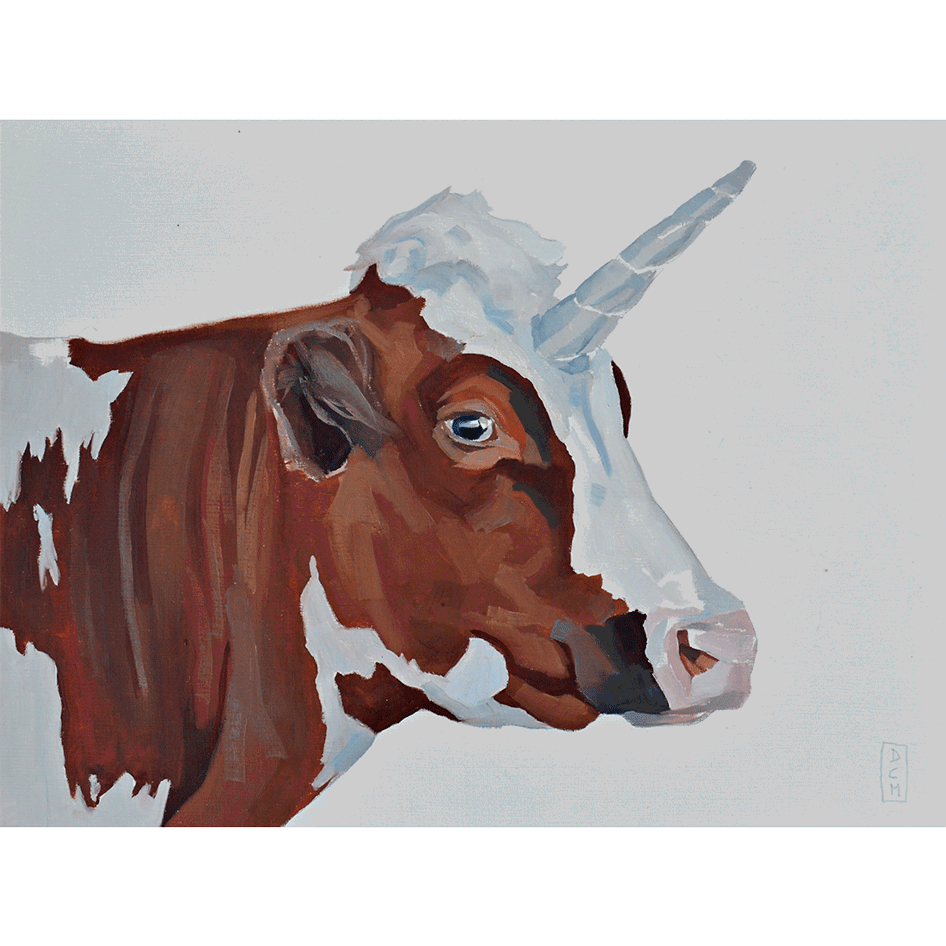
UNICORN-COW
Oil on paper
30 x 40 cm
