







WAR AND GLOBALIZATION
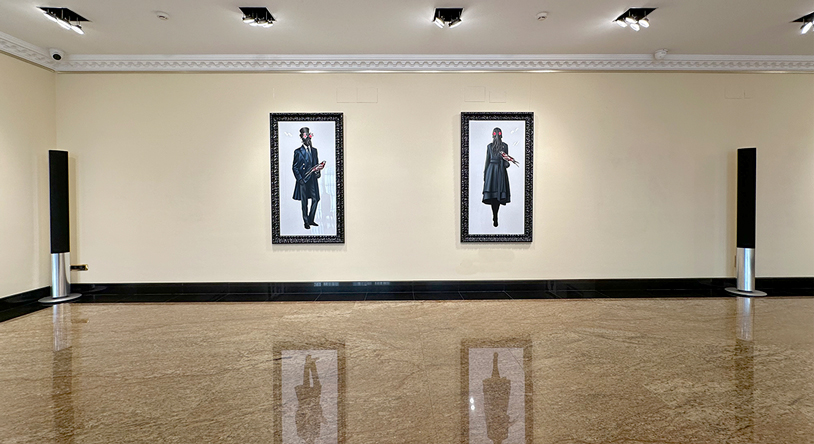
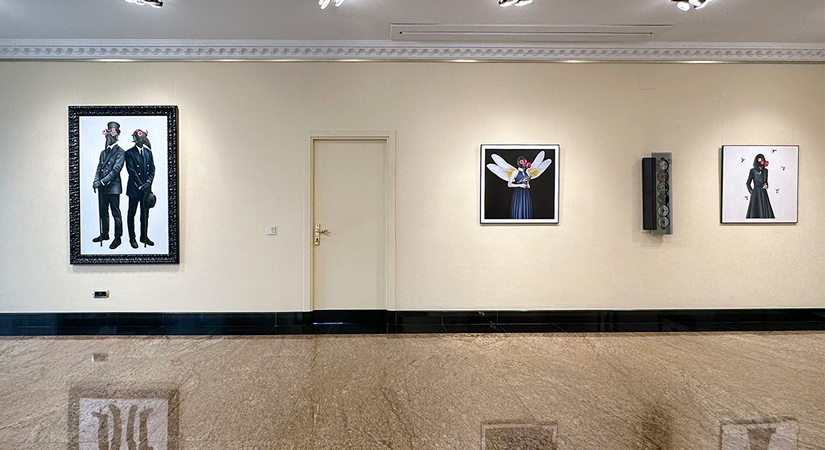
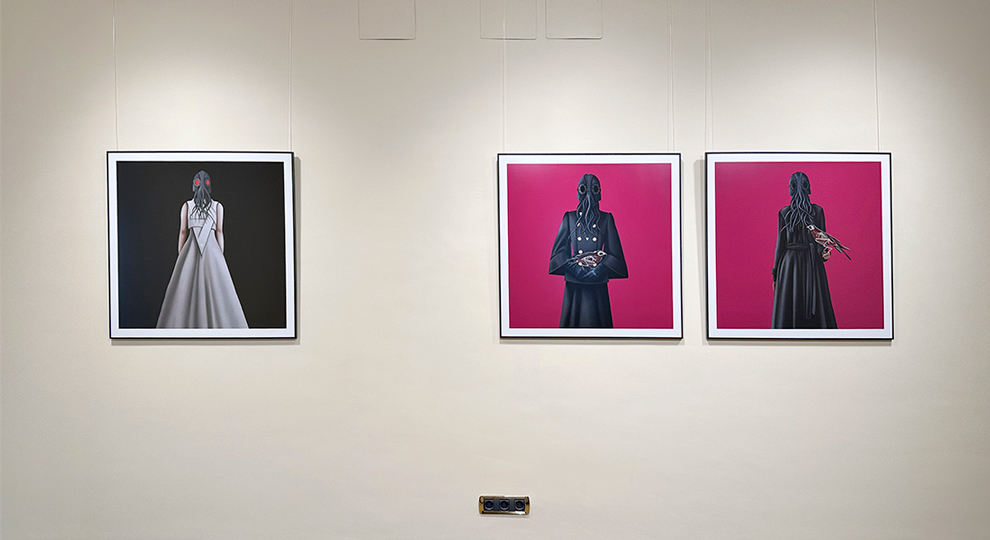
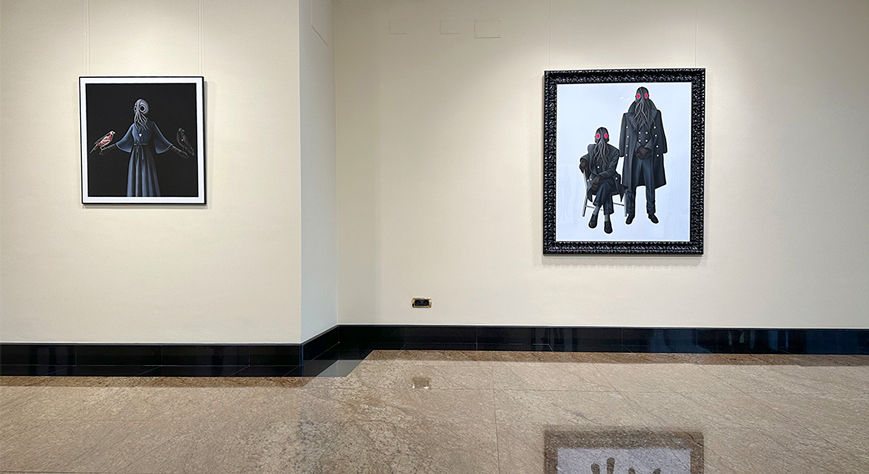
War and Globalization is Xevi Vilaró’s third solo exhibition at STOA, curated by Roberto Ballesteros and Conchi Alvarez. Oil paintings on methacrylate, the artist’s signature technique, make an impact when we look at the exhibition. They are full-length portraits of characters impeccably and elegantly dressed in dark tones, contrasting with the snowy background of the methacrylate. With this, the author invades the spectator’s space so that no one can escape his observation. And by shocking, the mechanism of interpretation of each individual emerges. In Vilaró’s previous exhibitions at STOA, “Morituri te salutant” and “Amazonas” we did this exercise. On this occasion, we have the privilege of having the personal exegesis of Roberto Ballesteros.
The exhibition is completed with prints on paper of the originals on display, oil paintings on methacrylate, as well as other works that make up this series.
DISCONTENT IN CIVILIZATION (War and Globalization)
The present selection of artworks by Xevi Vilaró may immediately evoke in you a diffuse sensation of receiving synthetic, agonizing messages from unsettling black leather masks, visual artifacts, hidden voices, or incongruous accessories for formal attire. You will rapidly perceive how they seamlessly conform to fragmented bodies that pose with languid indifference while deliberately revealing a counterpoint of ideas and materials that simultaneously suggest both harmony and subversion.
In each framed scene of this exhibition, a timeless space for controversy unfolds. Should you pause before a particular painting and confront the dilemma raised by the artist in this thematically curated arrangement throughout the gallery, you may discern the intentional journey of each piece and the extensive interconnection of the whole, forming a kind of phenomenology of the artist’s creative spirit within his work.
Once positioned in the middle of the room, one can almost “sense” the fluttering of the painted birds—zoomorphic metaphors of a reivindicative outcry that Vilaró masterfully commands, turning composition into reflection. The raw materials, the characters, the attire, and the decorative elements as stage props shape a proposal that fundamentally resonates with the topics explored in one of Sigmund Freud’s lesser-known works, “Civilization and Its Discontents”. In a mundane manner, directed at the observer, it opens a field of philosophical debate where ideologies associated with phenomena such as War, Globalization, Globality, Violence, Peace, Ethics, and Terrorism converge, thus initiating the debate.
Throughout the human epic, the dazzling—yet terrifying—wonders of Civilization have been integral to the universal process of humanizing barbarism, an unceasing globalizing campaign convinced of the evangelical necessity of Westernizing the East. From the very first encounters with the so-called savage, these missions brought forth a world of mythologies, utopias, and visionary Argonauts who set out in search of two-headed monsters and returned instead with flowers, animals, and plants. With each attempt to civilize the so-called gentle barbarians, the civilized civilizers never ceased to advance, propelled by the transcendent orthograms they projected—always pressing forward with unwavering faith in revealed truths, ever loyal to their respective programs. These programs may have been aesthetic and vengeful, like the Nazi project; genetic and eternal, like the faith of the Jewish people; or soteriological, like the promise of Jesus Christ to humankind. Yet, for what reasons does the process of Civilization, in its metamorphosis into Globalization, give rise to Discontent?
We have the impression—an impression that could well simplify the phenomenon of Globalization—that we are living in a cosmopolitan World, a shared Globe, in which, even if we do not yet possess everything collectively, we at least share, intentionally, a great many things and witness how others, indeed, enjoy nearly all of them.
As an ideology, the “theory” of Globalization channels a pragmatic vision of the World, crystallizing the interests of a society as it confronts the interests of other societies or social groups. Only by delineating the specific interests against which the Idea of Globalization is opposed can we fully comprehend this ideology. Here, the principle holds true that a system of thought (or ideology) can only be understood when we identify its adversaries. It is easy to fall into the trap set by the confrontation between blocs during the Cold War and conclude that the ideology of Globalization is merely the response of victorious capitalism against communism. There would be ample reasons to argue in this direction, as Globalization indeed emerges after the fall of the USSR, at the end of the Cold War; thus, one might interpret it as the ideology of the victors against the vanquished communism. However, such a conclusion would be mistaken. If the Idea of Globalization replaces the Idea of Communism as a project for a universal global society, it is because it can replace it—that is, because it shares decisive common elements. Contraria sunt circa eadem (The opposite revolves around the same essence).
It is essential to consider that the Human Species possesses the structure of an attributive totality and is also idiographic, for we cannot conceive of more than a single Human Species as such, unfolding upon the Earth (the Globe) throughout its history. Consequently, we cannot speak of distinct civilizations beyond the analogy of attribution to the overarching process of Civilization itself. However, from this generative Species emerge multiple factions, engaged in perpetual struggle for survival—a biocenosis that constitutes the fundamental root of all Discontent experienced by the individual within the tribe, the people, society, or the State.
At this juncture, the discourse must return to the invention of the idea of Civilization. It is here that Western civilization owes a profound debt to the institution of the Church—not only for the existence of universities, charitable institutions, international law, Science, and other fundamental legal principles, among many other contributions. Western civilization is indebted to the Catholic Church far more than most people, including Catholics themselves, tend to acknowledge. The undeniable truth is that the Church played a foundational role in the construction of Western Civilization. Naturally, Western Civilization does not originate solely from Catholicism, for such a claim would overlook the decisive influence of Greek and Roman cultures, as well as the various Germanic peoples who inherited the Western Roman Empire. However, rather than rejecting these traditions, the Church has assimilated them, drawing from the finest elements of each. It is thus remarkable that Catholicism’s substantial and essential contributions have remained relatively unnoticed in popular culture—though not in the consciousness of artists as distinguished as Vilaro.
Roberto Ballesteros

XEVI VILARO

OCTOPUS SERIES III
Oil on methacrylate
170 x 115 cm

Detail of OCTOPUS SERIES III
Oil on methacrylate
170 x 115 cm

OCTOPUS SERIES I
Oil on methacrylate
150 x 95 cm

Detail of OCTOPUS SERIES I
Oil on methacrylate
150 x 95 cm

OCTOPUS SERIES II
Oil on methacrylate
170 x 75 cm

Detail of OCTOPUS SERIES II
Oil on methacrylate
170 x 75 cm

OCTOPUS SERIES II, Triptych 3
Oil on methacrylate
170 x 75 cm

Detail of OCTOPUS SERIES II, Triptych 3
Oil on methacrylate
170 x 75 cm