


19 May VOLTA BASEL 2025
19-22th of June
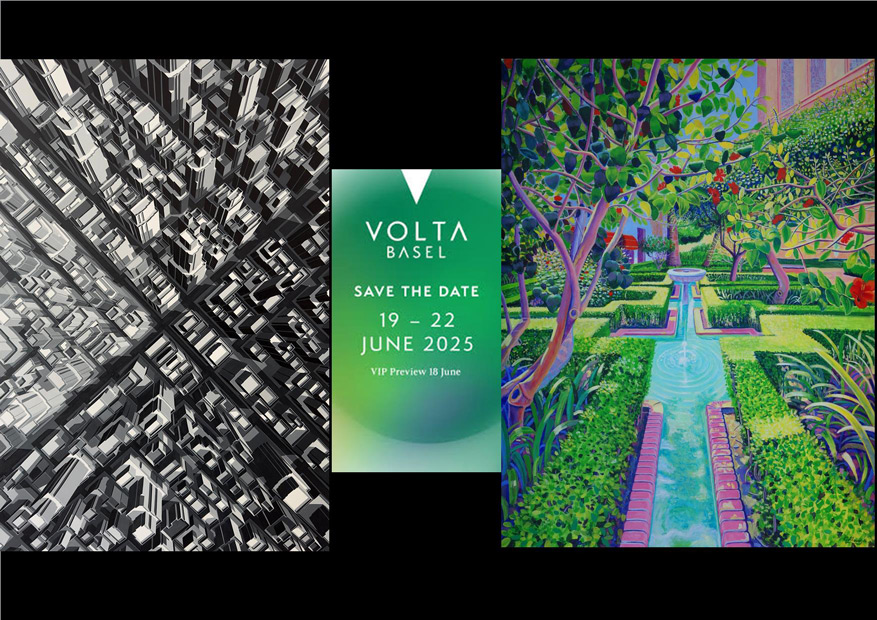
UTOPIAN URBANISM AND IDEAL NATURE: Geometry and Synexion.
The Synexion is the connection that links realities or aspects of reality that are necessarily dissimilar, yet interconnected. In this way, it is said that the two poles of a magnet or the obverse and reverse of a coin are synectically related. This same connection can be found between the two realities represented in the works of Conchi Álvarez and Miguel Ángel Iglesias.
In the gardens of Conchi Álvarez, the natural landscape is transformed by the artistic Demiurge of the painter, who transfigures the nature-naturing, Natura naturans, in its most genuine pantheistic definition, into the serene Hispano-Muslim garden, a passage and resting place for the day, where the harmonious laws of geometry are enjoyed, recreating the physical space, inherent to nature in its etymological sense—meaning fysis φύσις, the Greek term which, according to Aristotle, corresponds to the verb “to produce”, “to generate”, or “to grow”. Hence, Natura is the Latin term that gives meaning to the verb “to be born” or “nation”, being translated as Nature, inasmuch as it nominalizes that which is born, that which is engendered.
In the world of art, gardens with their vegetation, across different historical stages, have occupied a distinguished place, though not a preeminent one, when placed alongside architecture or sculpture. In us is ingrained the idea that a work of art must possess the highest degree of durability and stability, and produce the most profound effect. In this regard, the landscape architect, on the other hand, works with a material that undergoes the most varied degrees of vitality and both organic and inorganic corruption, and is only partially subjected to a stylistic will. Conversely, gardens always express their artistic essence in a manner accessible to all, and their constructive approach is practically immediately comprehensible, while a poetic or literary composition cannot be understood without appropriate preparation. It could be said that no spirit, not even the most rudimentarily cultivated, fails to capture, albeit in a diffuse way, the beauty of an artistically conceived garden.
As a manifestation of a constructive thought, the garden always entails a guiding idea and a compositional process capable of capturing, in the chosen natural space, the entire essence of an art. The character and meaning of a garden reflect the disposition, culture, taste, and sensibility of its creator. Let us take as a quick example: the French garden, the direct heir of the Italian garden, which expands and stretches the Renaissance conception, transferring it to undulating terrains and vast expanses with broad perspectives. Removed from demands of sentimental order, the French garden seeks effects of compositional perfection, in line with the Cartesian spirit of the Golden Age, which views the garden as an expression of logical, harmonious, and rational intelligence, but also, in contrast to the Italian garden, the French garden grants a more respectful treatment to the naturing elements in order to model its nature without forcing it.
Synectically, from the organized nature of the art of gardens emerges the city of skyscrapers by Miguel Ángel Iglesias. This utopian city is perhaps grounded in an essential, enantiomorphic nucleus of the city. Upon the pale earth of the canvas, favored or marked by the gods or muses, in the manner of Roman city founders. From his studio, the artist, perhaps unwittingly, founds his MAI land. A pictorial city that has become, with talent, patience, and meticulous work, the most singular project in the history of constructivist urbanism, and perhaps, its true artistic homeland, which he shares in his exhibitions from multiple perspectives, where any observer can inhabit it for a time, traverse its colorful spaces, leap over rooftops, streets, or the very ceilings. The artist has constructed his utopian city, geometrically bathed in sunlight, with an eternal dawn that encourages the traveler who soars above it to seek the peace of being entirely alone in an imaginary city and to savor every stroke.
But how would this urbanism fit into the definition of a city? It is not a matter of differing definitions referring to differing conceptions, or cities that are constitutionally not cities. It is verifiable evidence that a Greek polis, a medieval city, a Christian villa, a Muslim medina, a city-temple like Beijing, and a commercial metropolis like New York, are entirely distinct.
A definition of thematic synexion would be that of Ortega y Gasset, for whom the city par excellence is the Mediterranean city, where the essential element is the gardened square. The city, he states, is, above all, a small square, an agora, gardens—places for conversation, dispute, eloquence, and politics. But the city can also be a state of soul, a set of customs and traditions, with the feelings and attitudes inherent in the morals of each city-state, which are transmitted across generations. The city, in other words, is not merely a physical mechanism or an artificial construction. It is implicated in the vital process of the people who compose it. It is a product of human nature—there is no doubt about that. Where planning plays a transcendental role in its endurance. Urbanists have studied what has been called the law of the survival of the plan. The analysis of the temporal evolution of cities has led to the observation that, while buildings transform and are replaced over time, the plan generally remains or undergoes only minimal rectifications. As in the city of Miguel Ángel Iglesias.
In the panoramic garden of Conchi Álvarez, not only are the buildings and stone elements immutable. The planimetric arrangement and configuration of the land are not relatively stable. Unlike the tranquil vegetation of the gardens in these paintings, they are not subject to growth or seasonal changes, thus the fixed and desired form is efficient, and the consistency of the framing is not coincidental—it offers a fairly accurate reference to the artist’s intent.
Roberto Ballesteros
Curator

MIGUEL ÁNGEL IGLESIAS

THE SQUARING OF THE CIRCLE (Detail)
Acrylic on paper
100 x 70 cm

THE SQUARING OF THE CIRCLE (Detail)
Acrylic on paper
100 x 70 cm

CONCHI ALVAREZ

BRANCH 1
Acrylic on panel
21 x 75 cm

CATHEDRAL GARDEN Det. (MALAGA)
Acrylic on panel
130 x 100 cm