


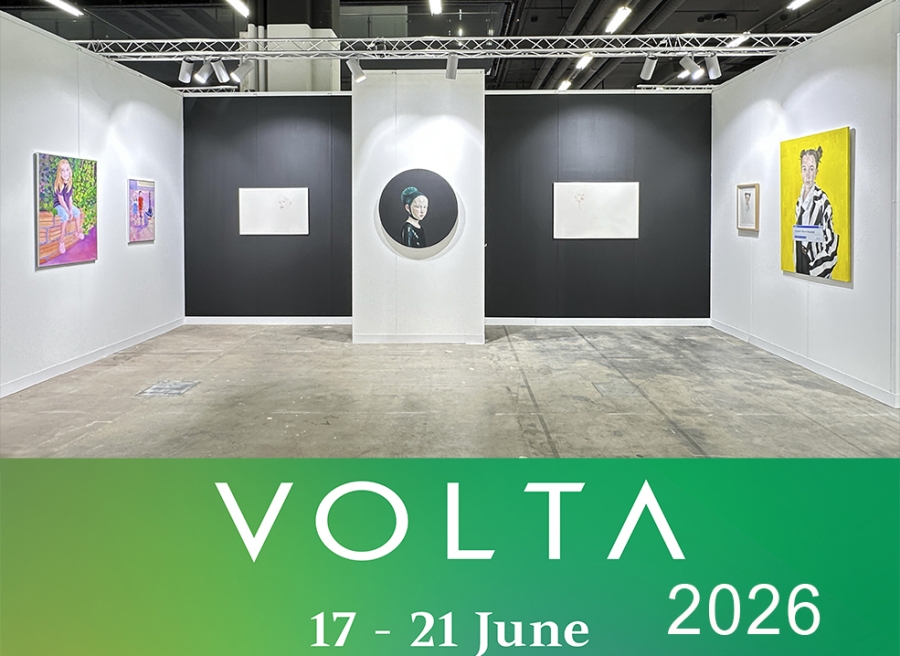
22 May VOLTA BASEL 2026
20-25th of June
For Volta Basel 2026, we are proposing a project on childhood, curated by Roberto Ballesteros and Conchi Álvarez. The project comprises children’s portraits offering three original and enriching perspectives. These images are the result of a cathartic process that brings forth the inner child within us all. In the case of the featured artists — Salustiano, Diego Cerero, and Conchi Álvarez — this process appears to have influenced their approach to childhood.
LOVE AND PEDAGOGY: Childhood as the Slow Dawn of Consciousness
Childhood is a period undergone through a succession of glances that ceaselessly seek in others a mirror in which to recognize oneself. From the innocence that observes without understanding to the emerging consciousness that begins to pursue the unknown, the child, in each of their stages, traverses inner ages that do not correspond to chronological years, but rather to the milestones placed along the path.
Each of these portraits captures a moment within that journey: surprise, timidity, the assertion of one’s own identity, the convergence of curiosity, fear and enthusiasm. Upon their visages lies silence, yet also a lucidity that foreshadows an as-yet-unknown future. The works complement one another in a finely harmonized counterpoint. They form a symphony of shared memory—the memory of the child we all carry within us, who still inhabits us when we contemplate the past with wonder. Here, the paintings become mirrors bearing images that defy both time and narrative. Since classical Greece, as is well known, education—paideia (from παιδός, “child”)—was conceived not merely as instruction, but as the art of shaping an ἄνεμος, a spirit, a soul, a psyche. The child was regarded as a seed of humanity, a being in transit toward the pursuit of ethical fulfillment in a life well lived. To educate meant to guide the child toward interior harmony, toward kalokagathía, where physical beauty (kalós) and moral goodness (ēthikós) are intertwined. Twenty-four centuries later, Jean Piaget described this same passage as a sequence of stages of thought, in which the child progresses from sensory play to logical reasoning, from immediate fascination to symbolic reflection. His theory reminds us that knowledge is not transmitted but constructed, step by step, in dialogue with the world.
This exhibition is perhaps oriented toward conceiving children as axes of consciousness, for it offers an aesthetic perspective on those invisible transformations. Through portraits and scenes of childhood, the assembled works reveal how a child’s gaze changes—how the child learns to see, to act, to imagine—and how, within that constant metamorphosis, each moment becomes imprinted, as in these works by Salustiano, Cerero and Conchi Álvarez, where the children appear with naturalness, without shame, and with pride. Child development unfolds through a succession of cognitive stages, in which thought is constructed through discovery rather than through mere transmission. From sensory experience to logical abstraction, the child crosses thresholds of knowledge that are also thresholds of an organoleptic soul. This carefully curated selection of works weaves together two perspectives—the philosophical and the pedagogical—and explores the artistic construction of gazes. Art, like education, becomes here a process of abstracting the universality of childhoods. The works form a symbolic itinerary of the child’s ages. They evoke amazement, timidity, self-awareness, dialogue with the other, the transcendence of play and the unknowingness of destiny.
In Love Shines So Bright by Salustiano, childhood is presented as a crystallized form of childlike consciousness. His portrait of a child, with a luminous body and a challenging gaze, evokes the Renaissance ideal of beauty reinterpreted for the present. It suggests a resignation to a medieval paideia, allegorically represented through the child’s attire, serious expression, and purity in both gaze and virtuous thought—moments preceding adolescence, when the immaculate soul still shines, untouched by history.
Diego Cerero’s portrait against a yellow background, with its visible brushwork and animated geometry, depicts an intermediate age—how children begin to perform a role they experience as their own place in the world. The pictorial construction, somewhere between unfinished drawing and consolidated figure, again evokes Piaget, recalling the moment when the structure of thought is still forming, poised between intuition and logic. For Conchi Álvarez, in her urban scenes of children in conversation, childhood opens onto collective space, onto the asphalt. There, perception is intertwined with gestures, shadows, and the urban environment, alluding to the social dimension of learning, the assimilation of the surrounding world, coexistence, and the enjoyment of fun, of another’s mistakes, of failure. The paintings capture that instant in which the child’s gaze examines the world, revealing both its charms and its disenchantments.
Altogether, they form an artistic and philosophical reflection on the sentimental significance of the very act of looking. For in every child—real or painted—there is mirrored the possibility of looking and looking again, as Paul Valéry once said of the sea… always beginning anew. The allegorical gaze emerging from these childhoods might be understood as an open door to the world, a metaphor for the psyche in the process of formation. Standing before the paintings in this exhibition, art and pedagogy overlap to suggest, as a conceptual artistic thesis, something akin to “paintings to look at and to let oneself be seen.” In this sense, childhood becomes the image of a continuous, unconscious gaze, which, before tasting the poison of reason, experiences the happiest moments of its infinite life—relishing light, scents, sound, and the faces of others. Yet comes the moment—silent and profound—when that light grows dim; the feeling of well-being transforms into something else. It becomes a skill to survive, accompanied by another form of consciousness, that so-called second birth of the soul, inaugurating a new and different life, already removed from the innocence of those first, unspoiled gazes.
So, Love or Pedagogy? One must exercise caution with the Educational Sciences; let us not repeat the fate of Apolodoro in Unamuno’s novel. That exemplary work concludes by demonstrating that life cannot be fully educated or domesticated by reason: when one attempts to substitute love with science, the result is the destruction of the human soul. Personally, it seems to me that Pedagogy should, above all, be applied to the child in order to transform them into a rational subject—that is, someone capable of acting and thinking within the cultural system that produces them; today, this would be a globalized and globalizing subject. This implies that consciousness is not a given, but rather a socially constructed form, an operative structure that emerges through interaction with language, technology, and the socialized global community. Thus, consciousness does not create the World; rather, the World—the globe, society, culture—creates consciousness. In this sense, the child does not awaken to consciousness from within, but acquires it through interaction with the environment, with norms, objects, and others. It could be said that learning—and, by extension, ethical and aesthetic education—shapes consciousness from the external toward the internal.
Roberto Ballesteros

SALUSTIANO
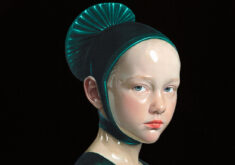
LOVE SHINES SO BRIGHT-JORGE VERDE (Detail)
Oil, natural pigments and acrylic resin on canvas
90 cm
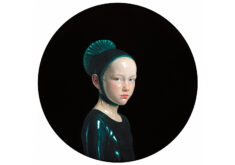
LOVE SHINES SO BRIGHT-JORGE VERDE
Oil, natural pigments and acrylic resin on canvas
90 cm

DIEGO CERERO
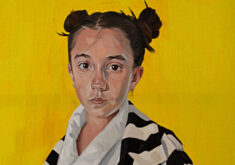
SYSTEM REBOOT REQUIRED (Detail)
Oil on linen
130 x 97 cm
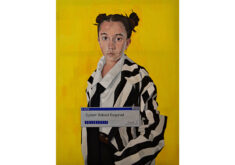
SYSTEM REBOOT REQUIRED
Oil on linen
130 x 97 cm

CONCHI ALVAREZ
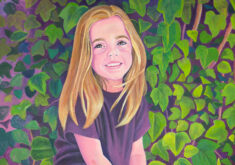
DAFNE EN EL CORRAL (Detail)
Acrylic on panel
100 x 75 cm
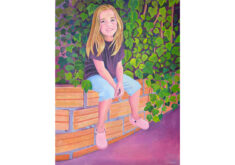
DAFNE EN EL CORRAL
Acrylic on panel
100 x 75 cm