


06 Nov ART MIAMI 2024
3-8th of December

For Art Miami 2024, we present a curated project on bullfighting, showcasing works by three Spanish artists: Salustiano, Conchi Alvarez, and Diego Cerero. “Bullfighter” and “bullfighting spectacle” are terms that don’t leave anyone indifferent, but beyond the extraordinary performance between the bull and the bullfighter, lies the origin of this almost liturgical celebration.
The stand is presided over by the feminine deity of Hathor, the Egyptian cow goddess, who represents the primordial origin of the cult of the bull as a sacred animal. The Pharaoh was the son of the sky goddess Hathor and Ra. In Egyptian mythology, Hathor, as the sky cow, devours her son, the solar god, by night. As an anthropomorphic goddess (with a female body and a head adorned with a solar disk and lyre-shaped horns), she receives and conceives her deceased son, the Pharaoh, through bodily fusion. Hathor was associated with the concept of the mother deity. The goddess of Salustiano presides over the scene from a modest altar resembling a contemporary altarpiece, prepared to receive offerings from bulls and bullfighters.
Indeed, the bull cult continued in the Mediterranean, perpetuating a millennial fascination. Noteworthy are the ritual ceremonies of Crete, where both male and female priests faced the bull. Therefore, this performance, in which the concept of death is ever-present, possesses an almost sacred atmosphere, wherein the mental and psychological preparation of the bullfighter is crucial. Embedded within this ancient tradition are the works of Diego Cerero and Conchi Álvarez.
Conchi Álvarez is the creator of a series focusing on bullfighting, where she focuses her attention on the man, the bullfighter, the “matador”, the on-foot bullfighter, unveiling the almost liturgical ritual embedded in the bullfighting spectacle. It is a process of purification wherein the man, stripped of his worldly attire, embarks on a catharsis to achieve inner sublimation. This delicate and silent protocol, where each garment represents a further step in spiritual transformation, establishes a ritual that is passed down from generation to generation. It involves the metamorphosis from man to hero, a demigod, poised to engage in a performance in the bullring where he will confront death face to face. It is in the bullring where the ritual continues, culminating in the “Vuelta al Ruedo”—a triumphant reward if the performance merits it—which is the focal point of this artist’s work in the project. In Conchi Álvarez’s works, the bull does not appear, though it is implied through the actions and gazes of the bullfighter, indicating its presence off-stage.
In this project, the bull is present in Cerero’s work. His paintings captivate with a particular magnetism, undoubtedly due to the scale of the canon employed, which approaches a sense of monumentalism and dominates the scenic space. However, most importantly, his bulls are portraits in which each animal is perfectly individualized. His atelier, located in a field surrounded by animals, explains this sympathetic gaze towards the bull, to whom he grants inner life and conveying a profound je-ne-sais-quoi that evokes that Mediterranean deity that has endured through the ages and remains fiercely relevant today.
A FORGOTTEN GOD
The three paintings selected for this exhibition surprisingly encompass an array of artistic elements that, when synthesized due to the limited space, facilitate a comprehensive, albeit succinct, exposition of the core, essence and trajectory of human religiosity across three very different phases of its history and artistic practice. These phases are exemplified through the works of Conchi Álvarez, Diego Cerero, and Salustiano. Each of these artists presents their work with remarkable individuality and technical proficiency, perhaps unwittingly unveiling a profound interconnectedness that transcends the descriptive titles of the works. This interplay among the artworks contributes significantly to the field of Philosophical Anthropology in Art.
Three paintings, three techniques, three dimensions of an anthropological space delineate three historical moments, each emerging from a nucleus of shared phenomena within the immense repository of religious materials available. This core concept of religions is referred to by the Latin term “numen”. The “numina”, and the numinous quality of “numina”, would be categories of religious life, and everything that occurs within this framework of relations between men and the numina must bear, without hesitation, the stamp of religiosity (see “El animal divino”, Gustavo Bueno, 1996).
Each of the three paintings in this exhibition embodies a period of primary, secondary and tertiary religiosity that would also cover -of course, intentionally- the totality of human evolution. In the primary phase of religion or nuclear stage, we will take as starting point the last moments of the middle Paleolithic in the order of 60,000 years, the time of “the hunter man”, where the numina are painted animals “coming out of the walls of the caves” by means of the fine pictorial art of the shaman who claims them. Parietal, ethological and angular art, rich in nuance, cannot be fully address here. They were primitive support of magical/religious numinosity. They are the so-called “inhabited stones” together with the “mountain gods”, horned animals ancestors of the numinous.
If we now place ourselves in front of Cerero’s Bull 1, we will see it emerging from the blank canvas towards us, evidently coming from the beyond, functioning as psychopomp numen (from the Greek ψυχοπομπóς, psychopompós, from psyche, “soul”, and pompós, “the one who guides or leads”); suddenly the animal appears halted and perplexed. Cerero leaves it drawn with the apparent simplicity of cave shamans/artists. However, compared to the bison of Altamira, in Cerero’s bull, we glimpse something contemporary: the frightened expression of the animal represents an inverted, ethological numinosity, where the bull’s astonishment seems manifest in the modernity of this meticulously executed piece. That traversable path from the beyond is much more present as we will see in secondary, mythological religions, where the animal figures appear fused to the human figures in a hypostatic union, as in the painting of the Queen/Goddess Hathor by Salustiano.
Virtually all Egyptian deities were conceived as animals or were associated with sacred animals. In Egypt, livestock was considered the main, though not the sole, embodiment of the mysterious life forces that humans refer to as divine. Secondary religiosity would encompass the period of the progressive emergence of the human figure as the mistress of animals among the numina, continuously interwoven with zoomorphic forms.
The hunting practices of the primitive Paleolithic hunter will pave the way for the domestication of wild animals in the Neolithic and Bronze Ages. However, this practice will continue, through metábasis (μετάβασις, transition), to be a projectable numen to the heavens and the mythological pantheon. The increasing figure of the moon can be perceived as a form composed of the two horns of a bull, and from this resemblance, the numinous bull will be reconstructed in the metabasis of the god Osiris, represented as a bull with pointed horns.
In Salustiano’s work “Zahara Kimono/Hathor Goddess”, the delirious mythology of this phase of secondary or mythological religiosity is clearly perceptible. This stage confers a pragmatic and functional rationality aimed at perpetuating the zoomorphic endlessness of the immortal kings who elevated the Egyptian people through their divinizing engineering works, which were strictly formalized in the worship and ritual of ceremonies. The goddess Hathor was generally depicted as a beautiful woman wearing a red solar disk between a pair of cow horns. She was the golden goddess who assisted women in childbirth, the dead in rebirth, and the cosmos in renewal. This complex deity could function as the mother, consort, and daughter of the creator god. Many lesser goddesses came to be considered “names” of Hathor in their contrasting facets of benevolence and destructiveness. Salustiano will reveal his brilliant update of the goddess.
The transition from secondary/mythological religiosity to tertiary religiosity should be understood as a critical period concerning secondary mythology. It embodies the religiosity of natural theology and monotheism, representing the metaphysical essence of ceremonies constructed as purposeful actions directed towards a God who imparts teachings of Goodness, Virtue, and Truth, not through works but through institutions and ceremonies. With the numinosity of the divine animal destroyed and the delirious mythology of secondary religiosity critiqued, there persist, much like in bullfighting, rituals transformed into games and aesthetic references that are not easily synthesized into a single idea.
Everything in bullfighting is ceremony, or more precisely, an assemblage of ceremonies. Ceremonies whose explanation can only be given in a religious key in man’s relationship with the sphere of a persistent numinosity. As exemplified by Conchi Álvarez’s triumphal presentation at Art Miami from her bullfighting collection, where one can perceive the ritual essence of bullfighting, the aesthetics of a ceremony with gestures, “suertes” (in bullfighting, each of the acts performed by the bullfighter), superstitions and a solemn smile of having risked one’s life one more afternoon in the metaphysical labyrinth of the Minotaur.
Roberto Ballesteros
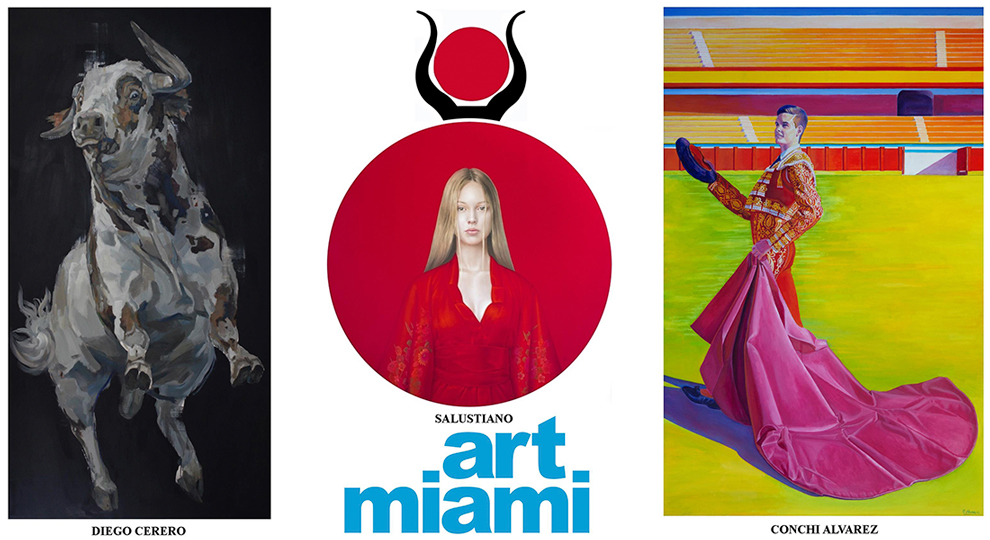

SALUSTIANO

INSTALLATION OF ZAHARA KIMONO AS GODDESS HATHOR
Installation from 2024. Painting of 2019
Installation: variable dimensions. Painting (tondo) 130 cm/51,2 inches

INSTALLATION OF ZAHARA KIMONO AS GODDESS HATHOR (Detail)
Installation from 2024. Painting of 2019
Installation: variable dimensions. Painting (tondo) 130 cm/51,2 inches
Salustiano is a Sevillian painter and master of the figurative field, who has deserved international recognition. His works of impressive portraits, stand out for the brilliant execution technique and fine elegance that only the classics achieve. In the contemplation of his work, the reminiscence of the most sublime Renaissance is unmistakable, with a composition of Quattrocento invocation, in which the flat monocolour backgrounds dazzle, in a resounding red, the “Salustiano red”, or an iridescent black, achieved by from natural pigments that saturate the background and overflow it, infecting the clothes. This manages to isolate the figures, mostly torsos, obtaining an effect of superlative three-dimensionality, as a break of glory of the 21st century. In this way, his figures become iconographic types of our time, managing to be the paradigm of a new neo-renaissance of resounding contemporaneity.
Our stand is presided over by the feminine deity of Hathor, the Egyptian cow goddess, who represents the primordial origin of the cult of the bull as a sacred animal. The Pharaoh was the son of the sky goddess Hathor and Ra. In Egyptian mythology, Hathor, as the sky cow, devours her son, the solar god, by night. As an anthropomorphic goddess (with a female body and a head adorned with a solar disk and lyre-shaped horns), she receives and conceives her deceased son, the Pharaoh, through bodily fusion. Hathor was associated with the concept of the mother deity. The goddess of Salustiano presides over the scene from a modest altar resembling a contemporary altarpiece, prepared to receive offerings from bulls and bullfighters.

DIEGO CERERO

THE FLIGHT
Oil on linen 2024.
270 x 140 cm/106,3 x 55,1 inches

THE FLIGHT (Detail)
Oil on linen 2024.
270 x 140 cm/106,3 x 55,1 inches
The bull cult continued in the Mediterranean, perpetuating a millennial fascination. Noteworthy are the ritual ceremonies of Crete, where both male and female priests faced the bull. Therefore, this performance, in which the concept of death is ever-present, possesses an almost sacred atmosphere, wherein the mental and psychological preparation of the bullfighter is crucial. Embedded within this ancient tradition are the works of Diego Cerero.
In this project, the bull is present in Cerero’s work. His paintings captivate with a particular magnetism, undoubtedly due to the scale of the canon employed, which approaches a sense of monumentalism and dominates the scenic space. However, most importantly, his bulls are portraits in which each animal is perfectly individualized. His atelier, located in a field surrounded by animals, explains this sympathetic gaze towards the bull, to whom he grants inner life and conveying a profound je-ne-sais-quoi that evokes that Mediterranean deity that has endured through the ages and remains fiercely relevant today.

CONCHI ALVAREZ

TRIUMPHAL WALK
Oil on canvas. Year 2023
160 x 100 cm/63 x 39,4 inches

TRIUMPHAL WALK (Detail)
Oil on canvas. Year 2023
160 x 100 cm/63 x 39,4 inches
Conchi Álvarez is the creator of a series focusing on bullfighting, where she focuses her attention on the man, the bullfighter, the “matador”, the on-foot bullfighter, unveiling the almost liturgical ritual embedded in the bullfighting spectacle. It is a process of purification wherein the man, stripped of his worldly attire, embarks on a catharsis to achieve inner sublimation. This delicate and silent protocol, where each garment represents a further step in spiritual transformation, establishes a ritual that is passed down from generation to generation. It involves the metamorphosis from man to hero, a demigod, poised to engage in a performance in the bullring where he will confront death face to face. It is in the bullring where the ritual continues, culminating in the “Vuelta al Ruedo”—a triumphant reward if the performance merits it—which is the focal point of this artist’s work in the project. In Conchi Álvarez’s works, the bull does not appear, though it is implied through the actions and gazes of the bullfighter, indicating its presence off-stage.